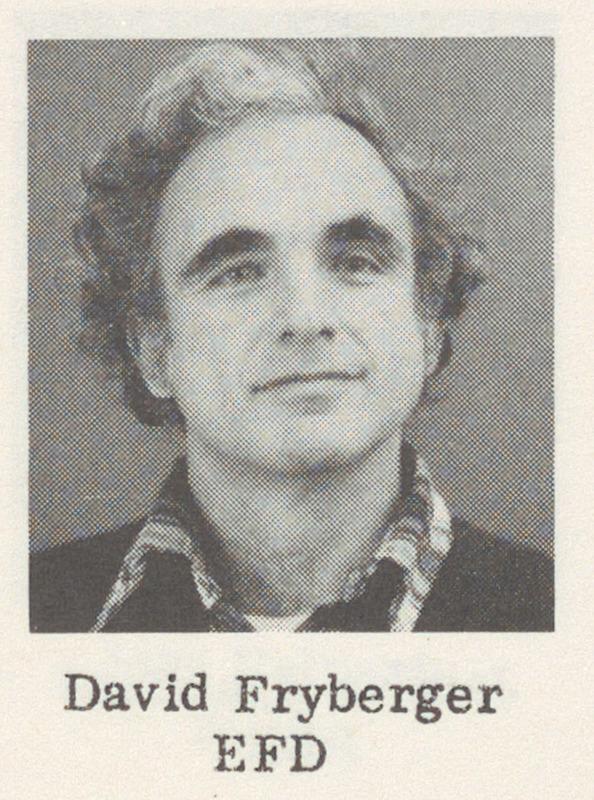
In Memory of David Fryberger
By Michael Sullivan
June 2, 2026 · Lab news
David Fryberger, a former SLAC physicist who worked at the lab for more than 30 years, died in May. A beloved colleague who held emeritus status in the Accelerator Directorate, David was a collaborator on the 1974 discovery of the J/psi particle, and went on to hold senior administrative positions.
You can read his full obituary, and his oral history from the American Institute of Physics.
His colleague, Michael Sullivan, contributed the following tribute:
David came to SLAC in 1967, became part of the operations team, and joined group G led by Mel Schwartz. He introduced several innovations to the operations and support groups. He and a colleague invented a precursor to the modern touchscreen for the accelerator operations staff. He also suggested that the accelerator, which was running at 360 pulses/second for about 4 months at the time, be changed to 180 pulses/second for 8 months, thereby doubling the running time for the SPEAR e+e- collider. By the early ‘70s, he had joined group C led by Burt Richter. The group was running the SPEAR collider and building the MARK I detector, the first 4𝜋 detector. David got his PhD under Valentine Telegdi, who had pioneered spark chamber detectors for high-energy physics. The MARK I detector used spark chambers inside a large solenoidal field. This had never been done before. David was in charge of making sure the chambers worked. David was also among the team members in group C who wanted to rescan the data points where the J/psi was eventually discovered.
In the late ‘70s, while David was working on substructure models of fundamental particles, he discovered another solution to Maxwell's equations. Unlike the photon, which is the only other known solution to Maxwell's equations, this new solution (which he coined the vorton) is stationary (time-independent) and can carry both electric and magnetic charge. Consequently, this solution requires the existence of magnetic charges and currents, which fully symmetrizes Maxwell's equations. The vorton can be thought of as a topologically stable “knot” of electromagnetic fields.
According to his theory, the vorton has a fundamental charge that is 25.83 times the electron charge, and the charge can be entirely electric, entirely magnetic, or a mixture of both. David had help from Stan Brodsky and BJ Bjorken from the Theory group, who critiqued his papers and clarified his thinking as he developed his theory.
The high intrinsic charge of the vorton led David to develop a substructure model of the fundamental particles of nature as a pair of vortons bound together by opposite magnetic charges, with a small residual electric charge. By symmetry, David's model predicts a strong, electrically bound pair of vortons, with a small residual magnetic charge. This results in a magnetic monopole with a magnetic charge equal to the electron's electric charge strength. This monopole (named magneticon) is predicted to be stable and should have been made in the Big Bang.
Having established his theory and model of the vorton, David then spent a good fraction of the rest of his career looking for manifestations or other evidence of either the vorton or the magneticon.
In the early 1980s, he was part of a collaboration that searched for magnetic monopoles in an experiment at the PEP-I collider in IR-10, the collision point beneath the computer building.
David was also the secretary of the Experimental Program Advisory Committee (EPAC), the head of the Experimental Facilities Department (EFD) Cryo group, and the chairman of the Safety Overview Committee (SOC) until his retirement in 1998.
David developed a model of ball lightning as the condensation of a cloud of vortons generated by lightning bolts. This model predicts certain signals that should be produced by ball lightning.
In 1992, he went to Langmuir Laboratory in New Mexico to look for a signal from ball lightning. Unfortunately, no storms came close enough to produce candidates at the laboratory that year.
He traveled to learn more about the lights seen during volcanic eruptions of Popocatepetl, Mexico's most active volcano, and to Norway to better understand the earthlights seen around Hessdalen. Earthlights are balls of light that emerge from the ground and can float for minutes at a time. This looked like a big brother to ball lightning. However, by the time David visited Hessdalen, the event rate was waning, and he obtained only a glimpse of one such event.
David set up a building in the research yard to create ball lightning in the laboratory, based on observational data and his model, which used vortons as an energy source.
In 1999, David learned about moving lights observed in a superconducting radio-frequency cavity at Jefferson Laboratory. These moving balls of light in the cavity looked like small versions of ball lightning. He worked with John Mammosser, a staff scientist/engineer who discovered the cavity lights. They performed several experiments at JLAB over the next seven years, collecting video data of the moving lights and trying to understand the conditions under which they are created. He wrote a NIMA paper summarizing their findings.
In the mid-90s, Michael Sullivan joined David in his efforts to detect evidence of the vorton theory. In 2006, they started meeting weekly over lunch to discuss his theory and models, as well as possible signals to look for. This weekly visit lasted up until his death. By about 2010, they began to realize that the particle physics field had not searched for a magnetically charged particle with the low magnetic charge value predicted by David. Therefore, the mass of such a particle could be as low as 12 GeV/c2. This opened up new avenues in the search for this particle. In addition, two SLAC workshops on Dark Matter searches (2009 and 2014) led David to the idea that dark matter might be a magnetically bound version of hydrogen with the magneticon and a magnetically charged stable version of the proton as the dark matter. His model explains the lack of a dark matter signal in all other detectors as well as explains the claimed dark matter signal seen in the DAMA/LIBRA experiment. In 2020, it dawned on David and Mike that an ionized dark matter signal might be detectable. Sullivan is in the process of searching for predicted signals from dark matter using David's model and plans to continue this effort.
David helped found the SLAC soccer club and was an avid player until 2006.
He is survived by his wife, Betsy; son, Mark, and his wife, Amanda; their two children, Laura and John Patrick; and two great-grandchildren, Peyton and Weston.